Roles
Tools Used
Research Design, Data Visualization, Systems Mapping
Timeline
Fall 2025
8 weeks
Total Team
Contribution
120 hours
Team
Daniel Santos, Michael O’Regan, Sydney Yeom
Maria Lucia Benavides
Individual
Contribution
50 hours
Figma, Excel, Google Documents,
ChatGPT
Overview
This project explores the complex systems behind food—how it is grown, processed, distributed, and accessed—and examines how something as basic and essential as eating is deeply connected to affordability, inequality, and sustainability.
Research Question
How do accessibility and affordability of healthy food options in the Greater Toronto Area (GTA) influence post-secondary students’ physical health, mental wellbeing, and academic outcomes?
Executive Summary
We examine the connection between a student’s access to a healthy food environment and their academic performance.
Key Chains
We interpret our system as a sequence of interconnected influences
Our analysis also considers how the system intersects with:


System Mapping
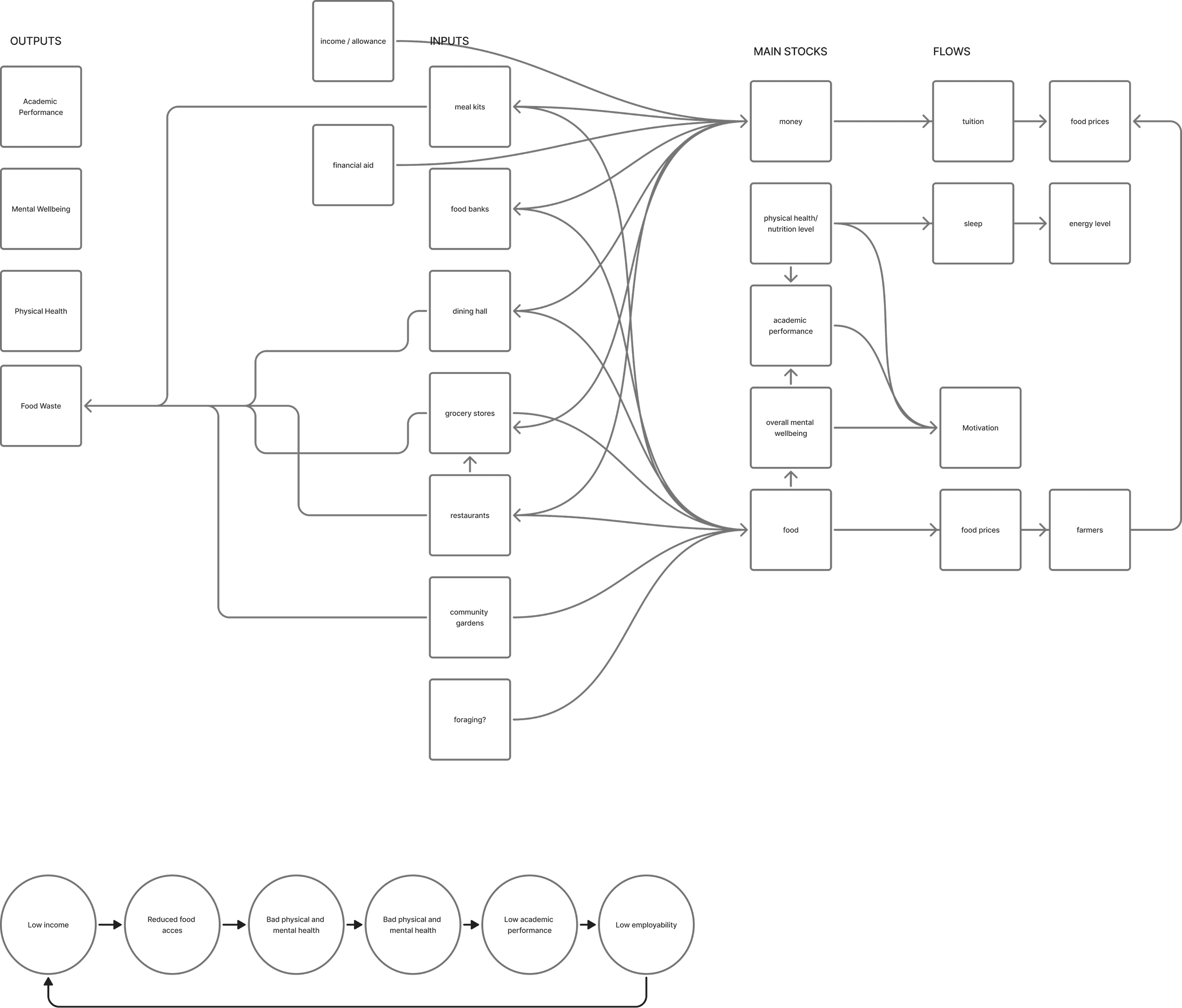
This project uses systems modeling and secondary research to explore how students’ food environments, closely linked to food security, shape academic performance. The system map below visualizes the key elements, relationships, and feedback loops within this environment, shown through both an early draft and a refined final version.
Initial System Brainstorm
Final System Map
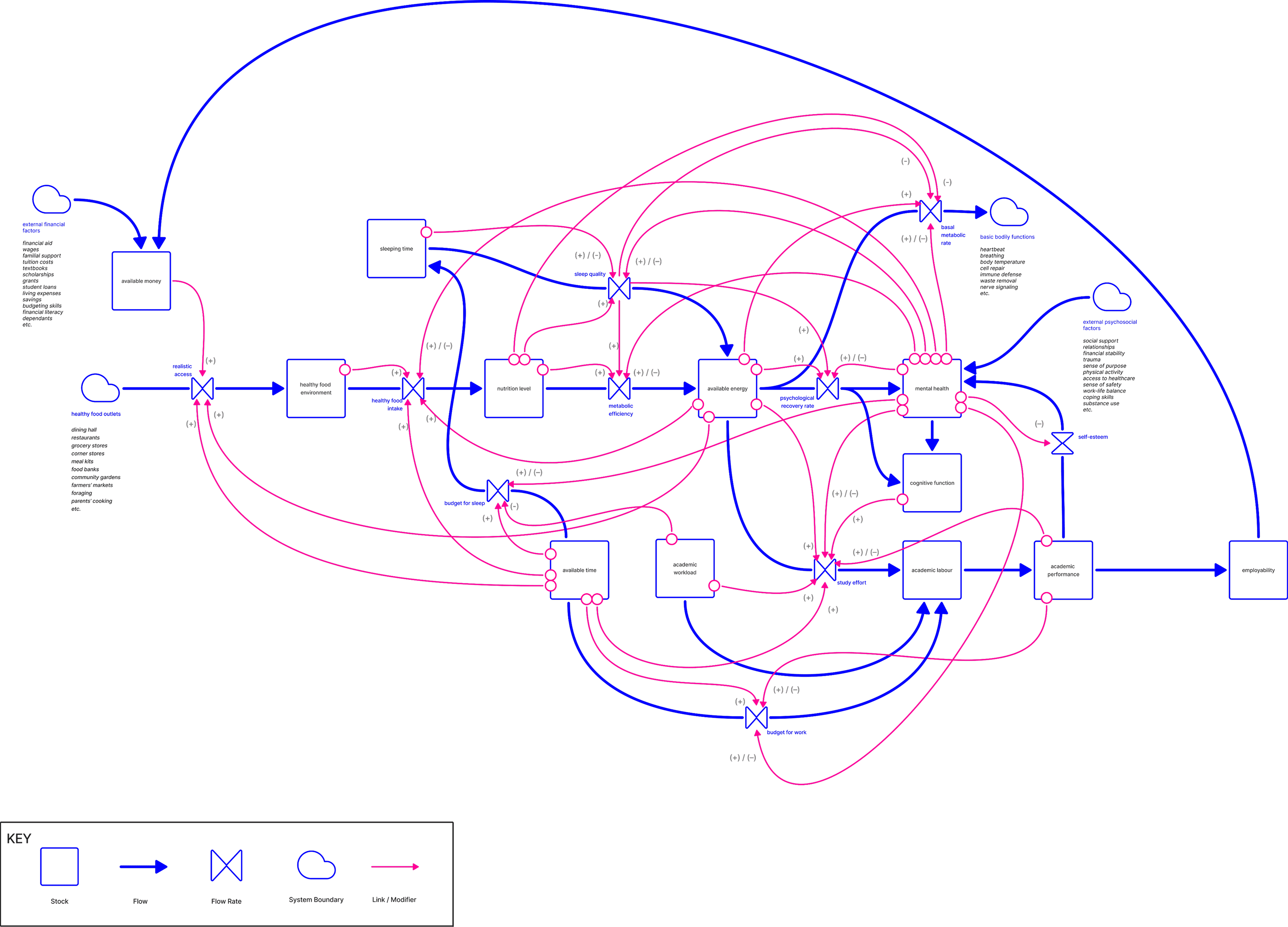
We organized our initial draft and synthesized its elements into a traditional Meadows-style stock-and-flow diagram, a systems modelling approach used to represent stocks, flows, and feedback loops (Meadows, 2008).
System Elements
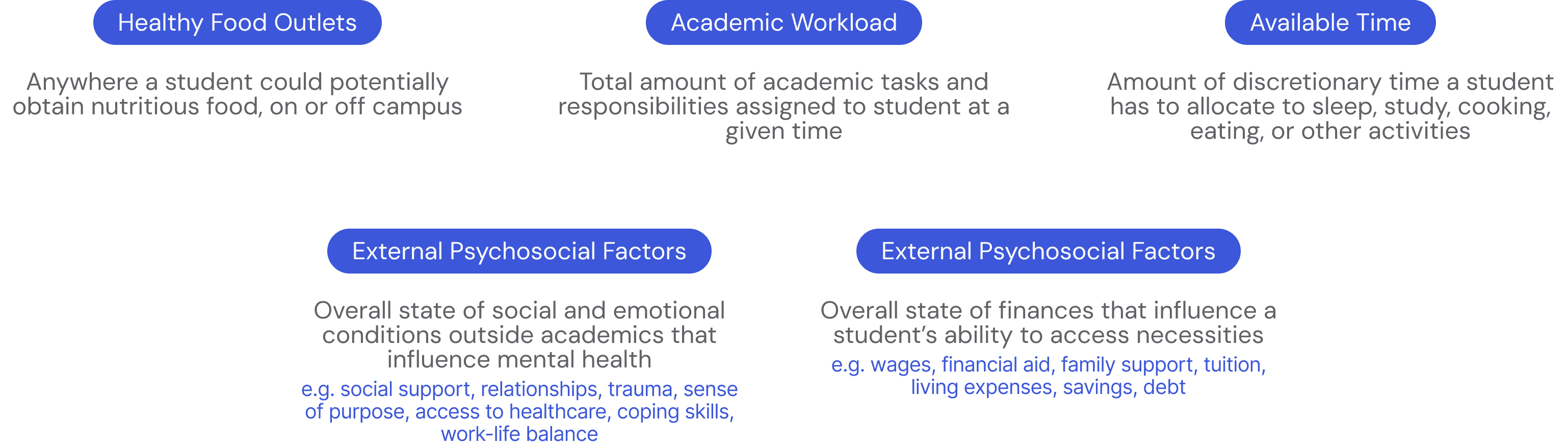
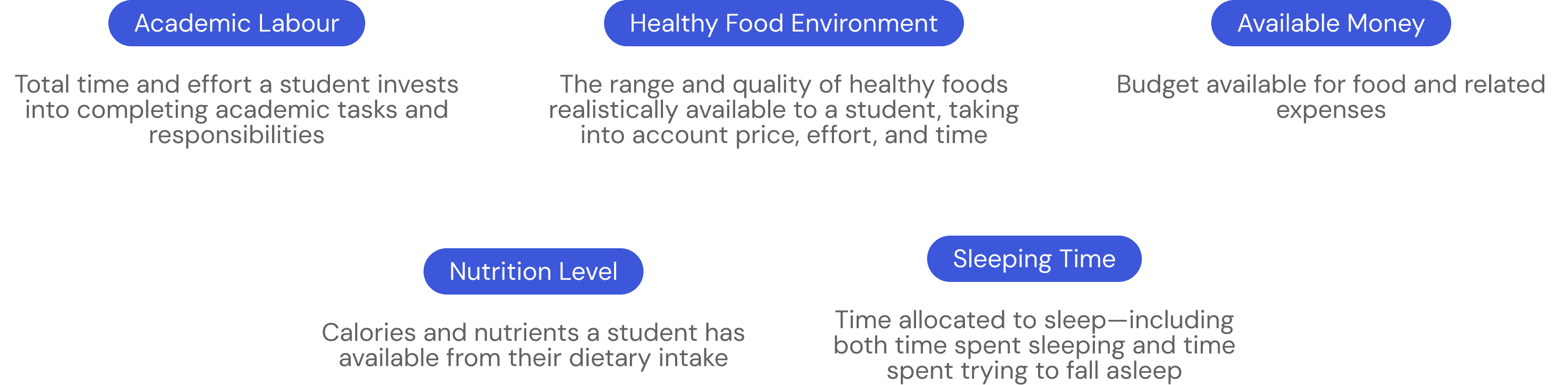
The system is structured around three stock categories: Inputs, Internal, and Outputs
Inputs
Internal
Outputs
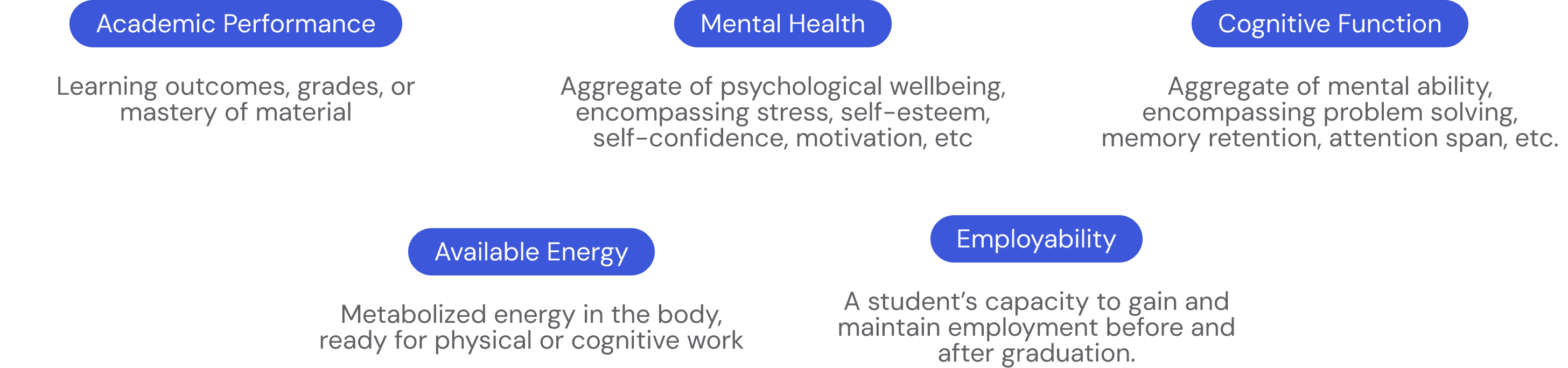
Stocks
See Complete System Maps
Food Access

Energy Recovery

Energy Expenditure

Resource Allocation

Emotional Regulation

Academic Outcomes

Flows
Feedback Loops
Reinforcing Loops
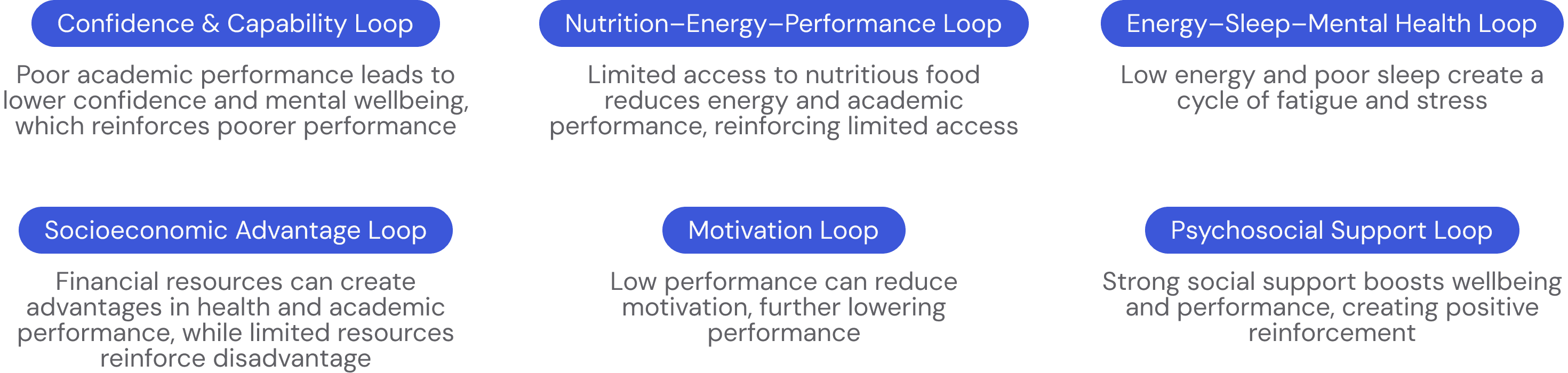
Balancing Loops

System's Purpose
Effectively process nutritional intake, available time, and academic workload into academic performance and employability.
Findings - Key System Relationships
Background Research
Hypothesis
Increased accessibility of nutritious food leads to better quality diets. Therefore, students with greater access to nutritious food will demonstrate better physical health, better mental wellbeing, and better academic performance compared to students with limited access.
Food Security & Accessibility
Increased access to nutritious food is strongly associated with higher-quality diets, particularly greater consumption of fresh fruits and vegetables. Public health research suggests that food environments with more healthy options support better dietary outcomes, reinforcing the importance of availability over simple choice.
Key Takeaway: Access shapes diet quality
Food Security & Physical Health
Access to nutrition plays a critical role in physical health through its effects on metabolism, energy regulation, and sleep quality. Research shows that both nutrient deficiencies and excesses can disrupt metabolic balance, while poor nutrition is also linked to inflammation and sleep disturbances.
Key takeaway: Adequate nutrition supports metabolic stability and restorative sleep.
Food Security & Mental Health
Financial and time pressures often push students toward nutritionally poor or repetitive food choices, increasing stress and disrupting sleep and energy levels. These patterns negatively affect emotional resilience and cognitive functioning, particularly for students already experiencing structural disadvantage.
Key takeaway: Poor nutrition exacerbates stress, fatigue, and cognitive strain.
Food Security & Academic Outcome
Food insecurity is consistently linked to lower academic performance through fatigue, impaired concentration, and increased stress, anxiety, and depression. Food-insecure students also expend significant time and energy securing meals, which can reduce course loads, increase dropout risk, and lower overall GPA.
Key takeaway: Food insecurity directly
undermines academic success.
Broader Implications
Rising living costs and stagnant wages are key drivers of food insecurity among students, particularly in the GTA. Profit-driven campus food systems often limit access to affordable, nutritious options, disproportionately affecting students from marginalized backgrounds and reinforcing broader socioeconomic inequities.
Key takeaway: Campus food environments reflect and amplify structural inequality.
See Complete Background Research
Contextual Research
Impacts on York University Students
An automated platform that provides personalized coaching to help users manage their spending and savings responsibly.
The Solution
See Complete Contextual Research
of York University's students live in on-campus residences
9.5%
of York University's student population are commuters
90%
of York University students identify
as a racial minority
70%
Student Demographics
York University’s student population reflects intersecting structural vulnerabilities that increase food insecurity risk. As one of Canada’s most diverse universities, the high proportion of racialized students, combined with a largely commuter-based population, creates uneven access to affordable and nutritious food.
Campus Food Environment
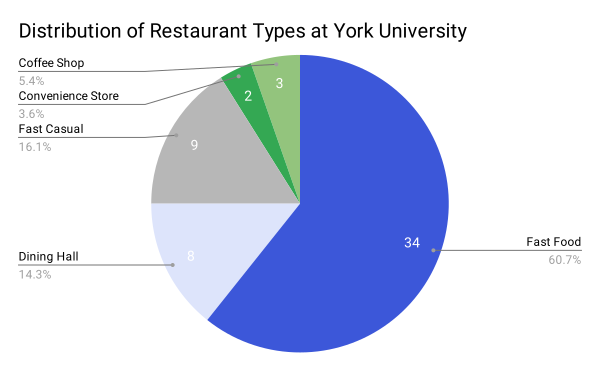
York University’s campus can be characterized as a food swamp, with a high concentration of fast food and convenience options and limited access to affordable, nutritious alternatives. Over 65% of on-campus food outlets fall into these categories, while the nearest grocery store is over 2 km from campus, making healthy eating logistically and financially challenging for many students.
Institutional & Economic Structures
York’s food environment is shaped by institutional leasing practices that prioritize revenue generation. A long-term food service contract with Compass Group Canada incentivizes partnerships with large fast-food chains that guarantee consistent profits, limiting opportunities for smaller or more nutritionally focused vendors to operate on campus.
Institutional & Economic Structures
York University and the York Federation of Students recognize these barriers and provide mitigation strategies such as food support centres, community gardens, and emergency financial aid. While these resources offer essential relief, they operate within a broader system that continues to constrain students’ food choices.
Conclusion
We claim that increased accessibility of nutritious food leads to better quality diets, and consequently students with greater access to nutritious food will demonstrate, compared to students with limited access, better physical health, mental wellbeing and academic performance.
Final Prototype
An automated platform that provides personalized coaching to help users manage their spending and savings responsibly.
The Solution
See Complete Contextual Research
This project approaches the university food system as part of a broader structure of inequality that disproportionately affects marginalized students. In response, we designed an interactive food environment map that visualizes how physical, social, economic, cultural, and institutional factors shape students’ access to nutritious food at York University. The map functions both as an analytical tool and an experiential interface, allowing users to explore the campus food landscape from multiple perspectives.
Turning research into structure
Working with systems modeling pushed me to synthesize dense, cross-disciplinary research into a clear system. Translating abstract findings helped surface patterns that were difficult to see in isolation, allowing research insights to become legible and actionable through visual structure.
Designing requires ethical decision-making
Designing the interactive map required ethical judgment, as choices around what variables to include and how to frame user input shaped how identity, access, and power were represented within the system.
Visualizing systems makes power visible
Creating an interactive map revealed how institutional policies, profit-driven leasing, and spatial design choices shape student outcomes. By visualizing this, it exposed power structures that are often invisible in individual experiences, reframing food insecurity as a systemic issue.
Key Takeaways